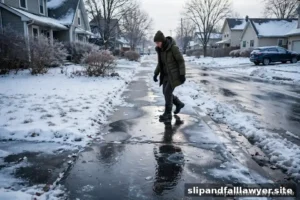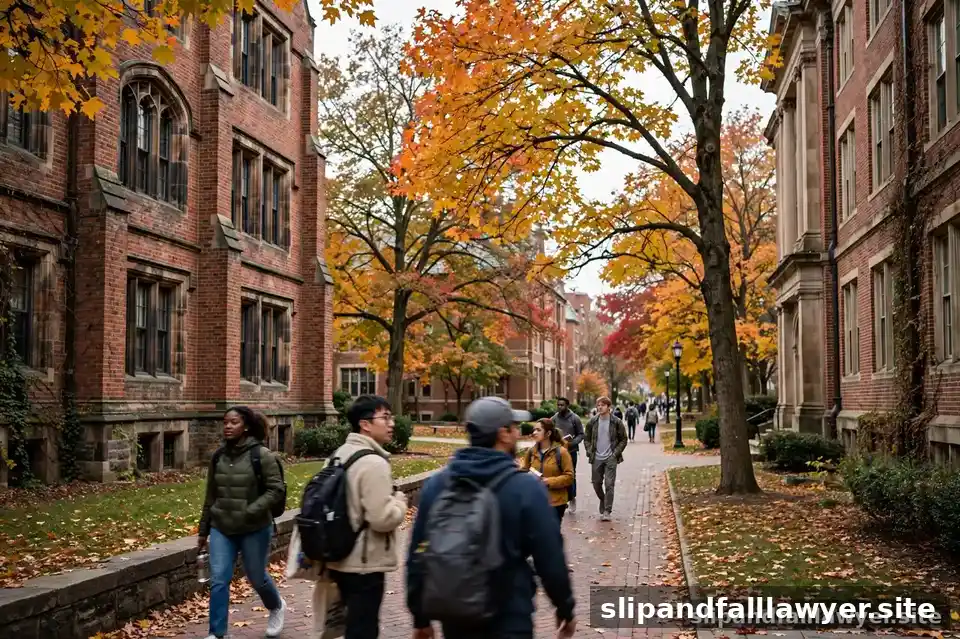
College campuses look idyllic — tree-lined walkways, historic buildings, packed stadiums — but they are also sprawling properties full of slip-and-fall hazards: icy quads, wet dormitory entrances, uneven pathways, crowded dining halls, and aging stairwells. Every year, students, visitors, and employees are injured in campus falls, and many assume nothing can be done because “it’s the school’s property.” That assumption is often wrong.
This guide explains students’ rights after a campus slip and fall: how claims differ at public versus private schools, where campus falls happen most, how to report an incident to the university, and the evidence and deadline traps that are unique to educational institutions.
Can You Sue a College or University?
Yes — but the path depends on what kind of school it is. Private colleges and universities are treated much like any other private property owner. They owe students, visitors, and other lawful entrants a duty to keep the premises reasonably safe, and an injured person can file a standard premises-liability claim against them.
Public universities and community colleges are government entities, which changes the procedure significantly. Claims against public institutions typically must go through special administrative steps first — most states require a formal notice of claim filed with the government entity within a short deadline (sometimes measured in months, not years) before any lawsuit can be filed. Miss that notice deadline and the claim can be barred entirely, regardless of its merits. Some states also cap the damages recoverable from public entities or grant immunity for certain discretionary decisions, like how the university prioritizes snow removal across a large campus.
The practical takeaway: if you are injured on a public campus, identifying the school as a government entity — and calendar-checking its notice-of-claim requirements — is the single most urgent legal step. Do not assume the ordinary personal-injury timeline applies.
Where Campus Falls Happen Most
Campuses concentrate the classic fall hazards in a pedestrian-heavy environment:
- Walkways and quads. Uneven pavers, tree-root uplifts, cracked concrete, and poor drainage that turns paths into ice sheets in winter. Heavy foot traffic between classes means hazards get encountered by hundreds of people per hour.
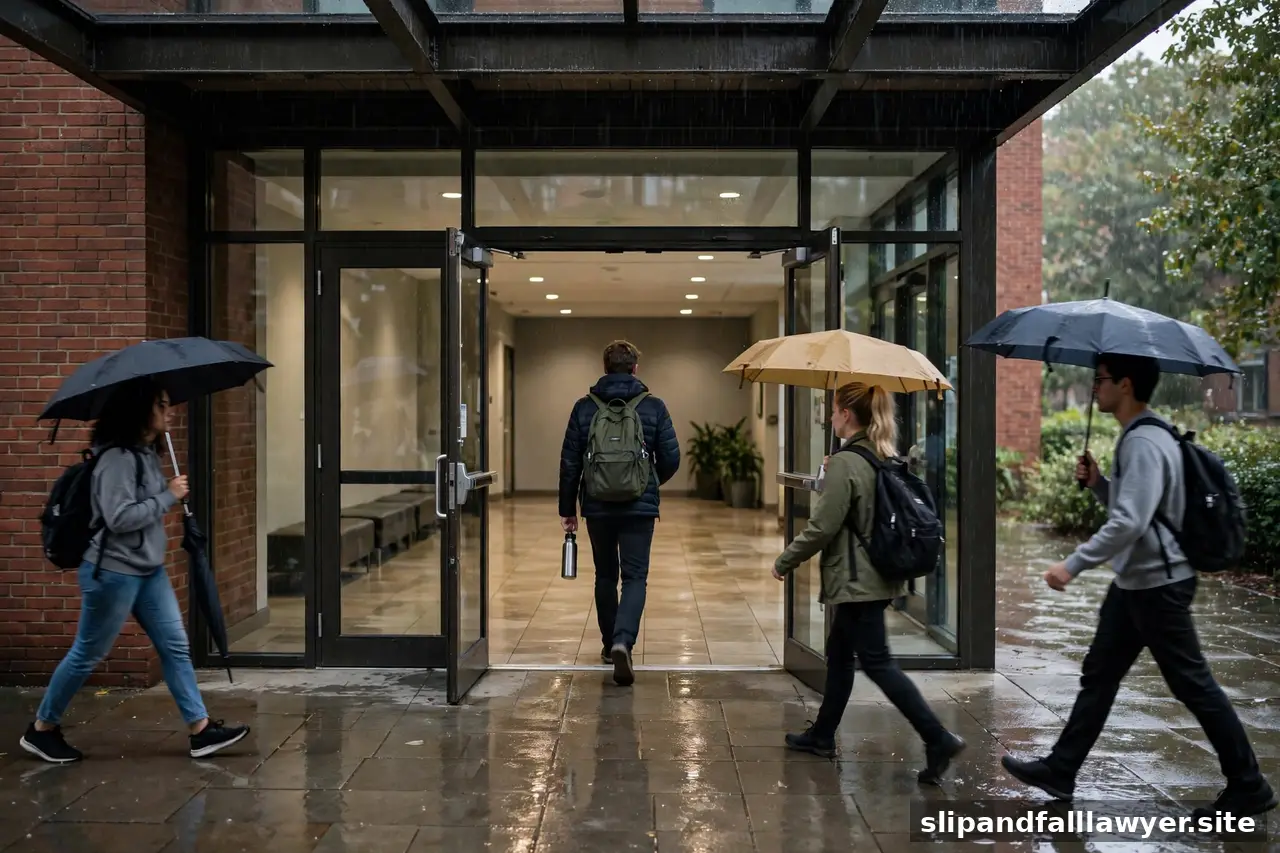
- Dormitory and building entrances. Wet tile lobbies with inadequate mats, tracked-in rain and snow, and revolving or heavy doors that create trip points. See the broader patterns in where slips happen most.
- Stairwells and lecture halls. Worn stair nosings, missing handrails, poor lighting in older buildings, and tiered seating with unmarked step edges.
- Dining halls and food courts. Spilled drinks and food in high-traffic serving areas, especially during rush periods between classes.
- Parking lots and garages. Potholes, faded striping, poor lighting, and untreated ice — often in lots far from the maintained campus core.
- Athletic facilities and stadiums. Wet locker rooms, crowded concourses, spilled concessions on concrete steps, and temporary event setups.
- Construction zones. Campuses are perpetually under construction; detours, temporary walkways, gravel, and uneven transitions are constant hazards.
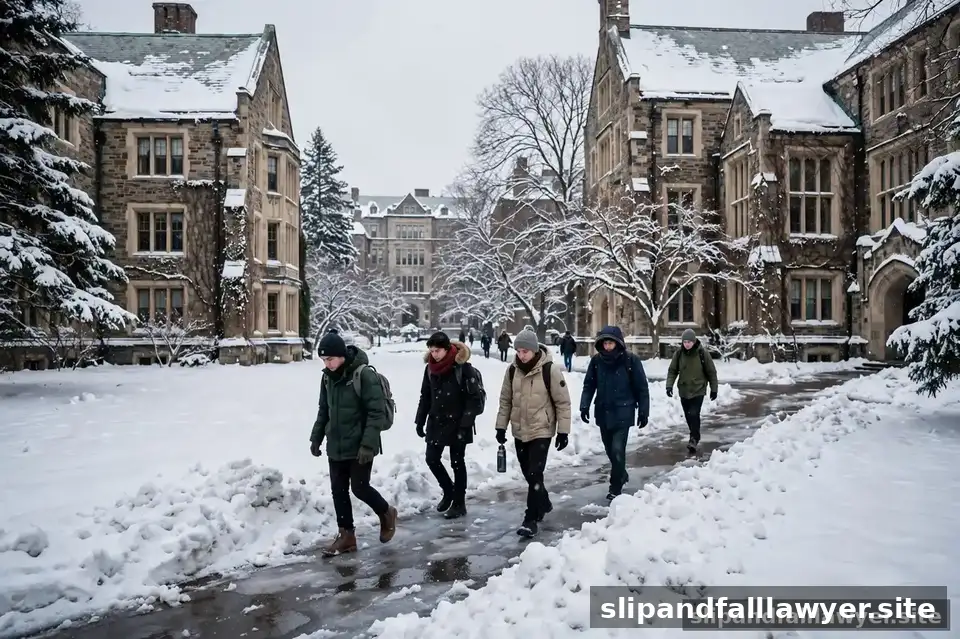
Winter deserves special attention on campuses: large universities cannot treat every walkway simultaneously, but they are expected to prioritize high-traffic routes and building entrances. Our winter slip-liability guide covers the storm-timing and footwear issues that dominate cold-weather campus cases.
Reporting the Fall to the University
How you report matters as much as whether you report. Universities have their own internal machinery — campus police, facilities management, student affairs, risk management — and a report filed in the wrong office can vanish into bureaucracy.
- Report immediately, in writing. Notify campus police or campus security first — they create official incident reports — and follow up with facilities management if the hazard is a maintenance issue (broken step, ice, lighting). Keep copies of everything you submit.
- Report to more than one office. An email to both campus police and the facilities/maintenance department creates parallel records and makes it harder for the report to be “lost.”
- Be precise about location. “The north stairwell of the science building, third-floor landing” beats “somewhere near the science building.” Precision helps investigators find the hazard — and later proves the school knew exactly where it was.
- Ask for the incident report number and a copy. You are entitled to know the report exists; get its reference number before you leave.
- Follow up in writing if the hazard is not fixed. A second email noting the hazard remains creates a paper trail of ongoing notice — powerful evidence if someone else is hurt later, and strong support for your own claim.
- If it is a public university, ask about the formal claim process. Many schools publish tort-claim or notice-of-claim procedures; request them in writing and calendar every deadline.
Students, Visitors, and Employees: Different Standing
Your relationship to the campus affects your claim. Students are the classic protected class — the university invited them, houses them, and controls their environment extensively, which supports a robust duty of care. Visitors — parents at orientation, fans at games, conference attendees — are owed the standard duty a property owner owes lawful visitors. Employees (including student workers) who fall on the job may have a workers’ compensation claim against the university as employer, potentially alongside a premises claim if a separate contractor controlled the hazard area.
One wrinkle for students: some universities argue that students “assume the risk” of obvious campus conditions — icy quads in January, for example. Assumption-of-risk arguments have limits, though; a school cannot rely on obviousness to excuse hazards it created through negligent maintenance, like a walkway that floods and freezes every winter because of a known drainage defect the school never fixed.
Evidence Unique to Campus Cases
Beyond the standard fall evidence — photos, medical records, witness names, covered in how to file a premises liability claim — campus cases offer distinctive proof:
- Maintenance work orders and logs. Universities run work-order systems; the history of complaints about your exact hazard (or the absence of any inspection) is discoverable and often decisive.
- Prior incident reports. If other students fell at the same spot, the school was on notice. Ask about prior incidents at the location in your records requests.
- Campus emails and alerts. Did the university warn students about icy conditions — or fail to, despite knowing? Mass-notification records cut both ways and are worth requesting.
- Surveillance footage. Campuses are increasingly camera-covered, particularly at building entrances and parking areas. Request preservation immediately; university IT departments overwrite footage on short cycles.
- Student witnesses. Classmates who use the same walkway daily can testify the hazard existed for weeks. Get their contact information fast — students graduate, transfer, and change phone numbers.
- Social media and campus forums. Students complain about campus hazards on social media constantly; dated posts about the broken steps or the icy hill corroborate notice. Preserve screenshots with timestamps.
Off-Campus Housing and Greek-Life Properties
Not every student fall happens on university-owned ground. Off-campus apartments are governed by ordinary landlord-tenant premises rules: the landlord typically must maintain common areas — stairs, walkways, parking lots — in reasonably safe condition. Document defects the same way you would anywhere else, and report them to the property manager in writing.
Fraternity and sorority houses occupy a gray zone. Some are owned by the university, some by national organizations, and some by local housing corporations — and the answer determines who you pursue. These properties also host large social events where crowds, temporary setups, and alcohol increase fall risks. If you are injured at a Greek-life property, identify the actual owner early through property records rather than assuming the university is responsible.
Deadline Traps to Watch
Campus claims have more clocks ticking than ordinary premises cases:
- Notice-of-claim deadlines for public universities are the big one — often far shorter than the general personal-injury statute of limitations. Treat this as a days-and-weeks problem, not a months-and-years problem.
- The ordinary statute of limitations still applies on top of any notice requirement, so both must be satisfied.
- University internal grievance deadlines may affect housing or academic accommodations related to your injury, even if they do not control the legal claim.
- Insurance notification clauses — if you hope to involve any applicable policy, late notice can create coverage defenses.
Because the notice rules for public institutions are technical and unforgiving, anyone injured on a public campus should get legal advice early — ideally within days, not months.
Practical Advice for Students and Parents
If you are a student: save the campus police non-emergency number in your phone, learn where your school’s incident-reporting portal is before you need it, and take the boring-but-effective precautions — proper footwear in winter, using handrails, reporting hazards you spot even when you are not the one hurt. If you are a parent: know whether your child’s school is public or private (it determines the entire claims procedure), keep copies of any incident paperwork your student brings home, and do not let the school’s internal process substitute for understanding your legal deadlines.
Universities manage small cities’ worth of property, and the law holds them to account as property managers — with extra procedural armor if they are public. Report fast, document thoroughly, respect the special deadlines, and the campus setting becomes just another premises case with unusually good evidence.
Finally, keep a personal injury file from day one: a folder — physical or digital — holding the incident report, photos, medical bills, correspondence with the university, and a dated journal of your symptoms and missed classes. Campus cases move slowly through institutional bureaucracy, and a well-kept file keeps your facts straight months later when an adjuster or administrator asks you to recount everything.
Disclaimer: This article is general information, not legal advice. Laws vary by state — consult a licensed attorney about your situation.