
A slip and fall can look minor in the moment and turn out to be anything but. People walk away from falls every day feeling embarrassed but fine, only to wake up the next morning barely able to move. Others know immediately that something is broken. Because the same kind of fall can produce anything from a bruise to a brain injury, it helps to understand the injuries these accidents most commonly cause, how they are typically treated, and — critically — why getting checked out promptly matters even when you feel okay.
This article describes these injuries in general terms so you know what to watch for. It is not medical advice and it cannot diagnose you. If you have fallen and something hurts — or even if nothing hurts yet but the fall was hard — see a doctor or visit urgent care. Early evaluation protects both your health and, if you pursue a claim, the medical record your case will depend on. Our step-by-step guide to what to do after a fall covers those first actions in order.
Fractures: The Most Common Serious Injury
Broken bones are the signature injury of slip-and-fall accidents, especially among older adults. When you slip, instinct throws your hands out to break the fall — which is why wrist fractures are so common — and your hip takes the brunt when you land sideways. Ankles fracture when the foot twists on an uneven surface. Ribs can crack when you strike an edge or railing.
Hip fractures deserve special attention. They are among the most consequential fall injuries, often requiring surgery and extended rehabilitation, and they disproportionately affect older adults whose bones are more fragile. A hip fracture can transform an independent person into someone who needs months of assistance. Wrist fractures, while less dangerous, can still require casting or surgical fixation with pins or plates, followed by occupational therapy to restore grip and motion.
Treatment for fractures generally follows a familiar path: imaging (usually X-ray, sometimes CT for complex breaks), immobilization with a cast or splint, or surgical repair for breaks that will not heal correctly on their own. Recovery then means physical or occupational therapy and a gradual return to activity. The CDC’s fall prevention resources note that falls are a leading cause of injury among older adults — a reminder that what looks like a simple slip can carry outsized consequences with age.

Head Injuries and Concussions
Any fall where the head strikes the ground, a shelf, a counter, or a railing deserves to be taken seriously — including falls where you feel fine afterward. Concussions, the mildest form of traumatic brain injury, do not always announce themselves immediately. Headache, dizziness, nausea, confusion, sensitivity to light, and difficulty concentrating can appear hours after the impact. More severe brain injuries can involve loss of consciousness, repeated vomiting, seizures, or unequal pupil size, all of which are emergencies.
Doctors evaluate head injuries with neurological exams and, when warranted, CT scans to rule out bleeding or swelling inside the skull. Concussion treatment is usually rest — physical and cognitive — followed by a gradual return to normal activity under medical guidance. Most concussions resolve, but some produce symptoms that linger for weeks or months, a condition sometimes called post-concussion syndrome.
The critical point: never “sleep off” a head strike without medical guidance, and never let embarrassment keep you from mentioning it. Head injuries are the category where delayed care carries the most risk, and where a same-day medical record documenting the mechanism of injury (“struck head on tile floor during fall”) becomes invaluable later.
Soft Tissue Injuries: Sprains, Strains, and Tears
Not every fall injury shows up on an X-ray. Sprains (ligaments), strains (muscles and tendons), and contusions (deep bruises) are extremely common after slips and falls, caused by the sudden twisting, overextension, or impact of landing awkwardly. A sprained ankle, a strained shoulder from catching yourself, a torn rotator cuff from landing on an outstretched arm — these are everyday outcomes of everyday falls.
Soft tissue injuries are notorious for two things: hurting more the day after than the day of, and being doubted by insurance adjusters precisely because they do not appear on imaging. Treatment typically involves rest, ice, compression, elevation, anti-inflammatory medication as directed by a doctor, and physical therapy to restore strength and range of motion. Severe ligament tears, such as a fully torn ACL from a twisting fall, may require surgical repair.
Because these injuries are invisible on scans, your medical documentation carries extra weight — consistent complaints recorded at each visit, measurable limits in range of motion, and a clear treatment plan. Our medical documentation guide explains how to build that record so soft tissue injuries are taken as seriously as they deserve.
Back and Spine Injuries
The spine absorbs enormous force when you land hard on your back or buttocks, or when your torso twists violently during a fall. Herniated or bulging discs, fractured vertebrae (compression fractures are a particular risk for people with osteoporosis), and severe muscle spasms around the spine are all documented outcomes of slip-and-fall accidents.
Back injuries are also the classic “delayed onset” injury: adrenaline masks the pain at the scene, and the stiffness sets in overnight. Symptoms to take seriously include radiating pain down a leg (often described as sciatica-type pain), numbness or tingling in the extremities, weakness, and any loss of bladder or bowel control — the last of which is a medical emergency. Diagnosis usually involves MRI when disc or nerve involvement is suspected, and treatment ranges from physical therapy and pain management to epidural injections or surgery for severe cases.
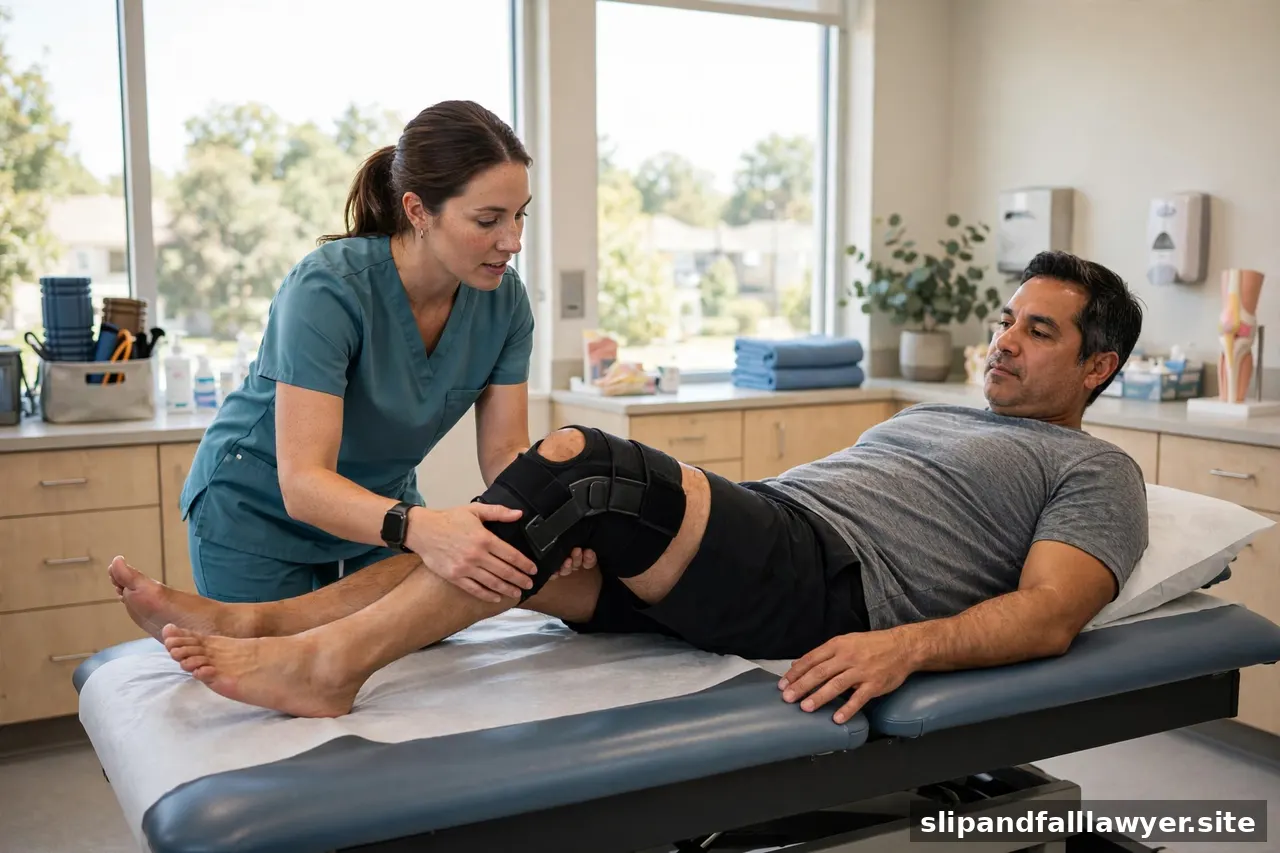
Back injuries frequently become long-term problems, which is why they feature heavily in discussions of the long-term costs of fall injuries. A disc injury that seems manageable at first can require ongoing treatment for years, and that future care needs to be accounted for — medically and legally — from the beginning.
Cuts, Lacerations, and Abrasions
Falls onto broken pavement, shelving edges, or debris-strewn floors produce cuts and deep abrasions. Most are minor, but lacerations that are deep, gaping, or on the face and hands may need stitches, and any wound sustained in a dirty environment carries infection risk. Puncture-type injuries from landing on sharp objects deserve prompt professional cleaning and evaluation.
Scarring is the long tail of laceration injuries. A facial scar from a fall on broken concrete does not threaten your health, but it affects appearance permanently, and that permanency is something the legal system recognizes as a compensable harm. Photograph wounds as they heal — dated photos of the injury’s progression are simple, powerful documentation.
Injuries That Show Up Late
Perhaps the most important pattern in fall injuries is delay. Adrenaline is a potent painkiller, and it is still circulating when you are filling out the incident report. Soft tissue inflammation peaks 24 to 72 hours after trauma. Concussion symptoms can emerge the next day. A hairline fracture may ache dully before the swelling makes it obvious.
This is why “I felt fine at the scene” should never be the end of the story. Monitor yourself for at least several days after any significant fall: new pain, stiffness, headaches, dizziness, numbness, swelling, or bruising that spreads. If anything emerges — or if the fall was hard enough that you are simply unsure — get evaluated. A medical visit three days after a fall with documented new symptoms is infinitely better than no visit at all, though same-day evaluation remains the gold standard.
Recovery Timelines: Why Patience Matters
Different injuries heal on very different clocks, and mismatched expectations cause real problems. A simple fracture in a healthy adult may heal in six to eight weeks; a complex fracture requiring surgery can take several months before normal activity resumes. Soft tissue injuries often improve steadily over weeks but can flare up if activity ramps up too fast. Back injuries are the least predictable of all — some resolve in a month, others become recurring issues managed over years.
The danger is returning to full activity the moment you start feeling better. Healing tissue is weaker than it will be, and re-injury during recovery can be worse than the original fall. Follow your provider’s timeline, not your optimism: complete the prescribed physical therapy even after the pain fades, respect lifting and activity restrictions, and keep follow-up appointments until you are formally discharged. Rushing recovery does not just risk your health — a documented re-injury caused by ignoring medical advice gives the insurer a brand-new argument that your ongoing problems are your own doing.
When to Seek Care: A Practical Rule
Use this rule of thumb: if the fall was hard enough that you are reading an article about fall injuries, it was hard enough to get checked out. Urgent care and emergency departments see fall injuries constantly; you will not be wasting anyone’s time. Bring a clear account of how you fell and what struck what — “slipped on wet tile, landed on right hip and struck head on floor” — because the mechanism of injury guides the examination.
Tell every provider that the injury came from a fall on someone else’s property, and make sure that fact appears in the medical record. It seems like a small detail, but months later, when an adjuster reviews your file, a record that consistently ties your treatment to the fall is the difference between a smooth claim and a fight over causation. Then follow through: attend follow-up appointments, do the physical therapy, and take the medications as prescribed. Gaps in treatment get weaponized against claimants, a problem we address directly in the documentation guide.
Falls injure the body in predictable patterns, but every body and every fall is different. Take the injury seriously, get it documented by professionals, and give yourself the medical foundation that both your recovery and any future claim will rest on.
Disclaimer: This article is general information, not legal advice. Laws vary by state — consult a licensed attorney about your situation.