Every slip and fall claim rests on a single legal question asked before any other: did the property owner owe the injured person a duty of care? If the answer is no, the claim ends there — no matter how bad the hazard or how serious the injury. If the answer is yes, everything else in the case flows from what that duty required.
Duty of care sounds abstract, but it’s a practical concept: it’s the law’s way of saying what a property owner must do to keep people safe. This guide explains what the duty of care means in premises liability, how it changes based on why you were on the property, and where the edges and exceptions lie.
What “Duty of Care” Means in Plain English
In everyday language, a duty of care is an obligation to act reasonably to avoid harming others. In premises liability, it’s the obligation of people who own, lease, or control property to keep that property reasonably safe for visitors — and, in limited ways, even for people who aren’t visitors at all.
“Reasonably safe” is the key phrase. The law doesn’t demand perfect property. It doesn’t require owners to eliminate every conceivable risk or to guarantee that nobody ever falls. It requires them to take the precautions a careful, sensible property holder would take: inspecting for hazards, fixing what they find within a reasonable time, and warning visitors about dangers that can’t be fixed immediately.
Whether an owner met that standard is judged case by case. A court or jury looks at the nature of the property, the kind of hazard, how long it existed, how obvious it was, and what it would have cost or taken to address it. A small spill in a busy store for thirty seconds is judged differently than a broken stair rail that sat unfixed for six months despite complaints. Context is everything — which is why these cases turn so heavily on evidence about the property’s condition over time. Our overview of what a slip and fall claim is puts this duty in the broader context of how claims work.
The Three Visitor Tiers: Why Your Status Matters
Here’s where premises liability gets distinctive. In many states, the strength of the duty an owner owes you depends on why you were on the property. The law traditionally sorts visitors into three categories, with the duty owed increasing at each step. (Important note: not every state uses this exact framework — some have simplified or abandoned it, which we’ll cover below.)
Invitees: the highest duty
An invitee is someone on the property for the owner’s business purposes or by public invitation — shoppers in a store, diners in a restaurant, guests in a hotel, patients in a clinic. Because the owner benefits from their presence, the law imposes the strongest duty: owners must inspect for hidden dangers, fix the ones they find, and warn about ones they can’t fix right away.
This is why stores are expected to have inspection routines — employees walking aisles on a schedule, checking for spills. An owner can’t just wait for someone to report a hazard; for invitees, the duty includes actively looking for problems. Most slip and fall claims involve invitees, because most falls happen in businesses people were invited to patronize.
Licensees: the middle tier
A licensee is a social guest — someone on the property with permission but not for business reasons. Think of a friend visiting your home, a neighbor stopping by, or someone attending a social gathering. The owner must warn licensees about known hidden dangers — hazards the owner knows about that the guest wouldn’t reasonably discover on their own.
The difference from invitees is meaningful: for a social guest, the owner generally doesn’t have to go hunting for unknown hazards. But if the owner knows the back steps are rotten and says nothing while the guest walks out with a tray of drinks, that silence can be a breach of duty.
Trespassers: the limited duty
A trespasser is on the property without permission. Owners generally owe trespassers no duty to keep the property safe or to warn about dangers — with two important exceptions. First, owners may not set intentional traps or engage in willful misconduct likely to injure trespassers. Second, many states impose a duty toward trespassing children when the owner knows children are likely to be drawn to a dangerous feature (an unfenced pool, an abandoned structure) and fails to take reasonable steps to protect them.
In practice, the trespasser category ends more claims than any other single factor. If you weren’t supposed to be there, the legal protections shrink dramatically.
How States Differ: Not Everyone Uses These Tiers
The three-tier system described above is the traditional rule, but it isn’t universal. A significant number of states have moved away from rigid categories toward a single standard: owners owe reasonable care to everyone lawfully on the property, with the visitor’s status being just one factor among many in deciding what was reasonable.
Other states keep the categories but define them differently, or apply special rules to particular situations — residential landlords, recreational land, or government property, for example. The practical takeaway: the visitor-tier framework is the right mental model for understanding how these cases are argued, but the exact rule that applies to your fall depends on your state’s current law. This is one of several areas where checking with a local attorney matters more than any general guide can convey.

What the Duty Requires in Practice
Regardless of the framework a state uses, the duty of care in real life comes down to a handful of concrete obligations:
- Regular inspection. Commercial properties should have systems for finding hazards — scheduled walk-throughs, employee reporting procedures, pre-opening checks. The busier the property, the more frequent the inspections should be.
- Prompt repair or remediation. Once a hazard is found (or reported), fixing it within a reasonable time is the core of the duty. What’s “reasonable” depends on the hazard: a spill needs minutes, a structural repair may need days with interim warnings.
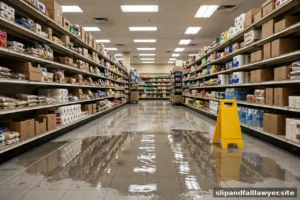
- Adequate warnings. When a danger can’t be fixed immediately, warning visitors is the minimum. Cones, signs, barriers, and verbal warnings all count — but they need to be noticeable and placed where people will actually see them before encountering the hazard.
- Attention to foreseeable risks. Owners are expected to anticipate the obvious: floors get wet near entrances when it rains, produce sections get slippery, parking lots ice over in winter. Seasonal and situational risks are part of the duty, not surprises. Winter weather falls are a textbook example of a foreseeable risk owners must plan for.
- Proper maintenance of safety features. Handrails, lighting, non-slip surfaces, and drainage systems only help if they work. Letting safety equipment decay can itself be a breach.
What a Breach of Duty Looks Like
A breach is simply the owner’s failure to live up to the duty described above. In slip and fall cases, breaches tend to fall into recognizable patterns:
- No inspection system at all — a store with no procedure for checking aisles, so spills sit for hours.
- Known hazard ignored — complaints about a broken step, a leaking pipe, or a dark stairwell that go unanswered for weeks.
- Warning without fixing, indefinitely — a “wet floor” sign left up for days instead of actually addressing the leak causing the wet floor.
- Fixing it badly — a repair that creates a new hazard, like an uneven patch or a mat that bunches up and becomes a trip risk itself.
Proving a breach is where cases are won and lost, and it leans on evidence: maintenance logs (or the suspicious absence of them), complaint records, witness accounts, and photos of the condition. Our guide to proving negligence walks through how each element, including breach, gets established.

What the Duty Does NOT Require
The duty of care has limits, and understanding them keeps expectations realistic:
- It doesn’t require perfection — only reasonable care under the circumstances.
- It doesn’t require warning about open and obvious dangers a reasonable person would notice and avoid.
- It doesn’t make owners insurers of everyone’s safety — they’re not automatically liable for every accident on their property.
- It doesn’t extend the same protection to trespassers as to lawful visitors in most states.
Insurers raise these limits early and often. A strong claim anticipates them: documenting that the hazard was hidden or hard to notice, that the owner had time to act, and that the visitor was lawfully present and acting reasonably.
Why Duty of Care Is the Foundation of Every Claim
Duty comes first in the negligence framework for a reason: without it, nothing else matters. You can have a terrible hazard, a serious injury, and a clear causal link — but if the defendant owed you no duty, there’s no claim. That’s why attorneys analyze duty before anything else, and why understanding it helps injured people evaluate their own situations realistically.
The good news is that for most people hurt in ordinary circumstances — shopping, dining, visiting, renting — a duty of care clearly exists. The fight is usually about whether it was breached, not whether it existed at all. And that fight is waged with evidence, which is why documenting everything after a fall matters so much.
Disclaimer: This article is general information, not legal advice. Laws vary by state — consult a licensed attorney about your situation.
Duty of care is the promise the law extracts from property holders: keep your premises reasonably safe for the people you invite in. When that promise is broken and someone is hurt, the result is a premises liability claim — and proving the breach is the subject of our guide to proving negligence in a slip and fall case.